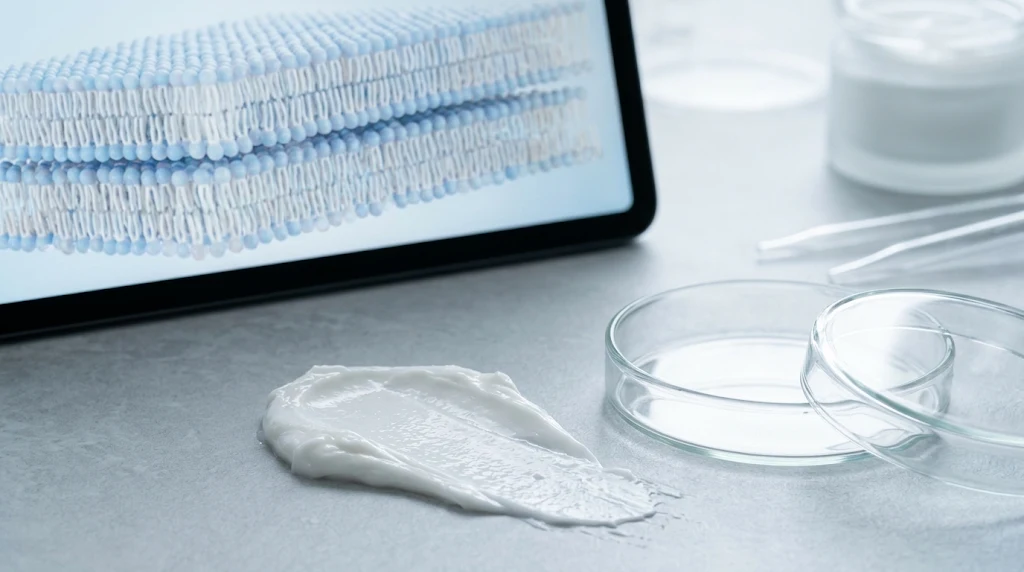
Choosing the right ceramide barrier cream is one of the most important steps in repairing dry, sensitized, or over-exfoliated skin. Yet if you have ever layered an expensive ceramide barrier cream onto tight, flaking skin—only to wake up feeling just as dehydrated hours later—you are not alone.
Ceramides have become the biggest buzzword in modern dermatology. However, from a cosmetic formulation perspective, most standard moisturizers fail to rebuild a compromised stratum corneum. Throwing isolated ceramides onto damaged skin without their partner lipids in the exact physiological molar ratio can actually delay recovery rather than accelerate it.
In this formulation breakdown, we decode the 3:1:1 physiological lipid ratio, explain why lamellar liquid-crystal engineering matters more than marketing claims, and examine how top R&D labs—including L’Oréal, Amorepacific, and LG H&H—formulate a true clinical ceramide barrier cream.
Why Your Ceramide Barrier Cream Needs the “Brick and Mortar” Triad
To understand why a single-ingredient ceramide barrier cream underperforms, look at the outermost layer of your epidermis: the stratum corneum. Dermatologists compare this protective shield to a brick wall:
- The “Bricks” (Corneocytes): Flattened, protein-rich dead skin cells filled with Natural Moisturizing Factors (NMF) such as amino acids, urea, and pyrrolidone carboxylic acid (PCA).
- The “Mortar” (Intercellular Lipid Matrix): A continuous, water-repelling lipid seal surrounding those bricks that prevents Transepidermal Water Loss (TEWL) and blocks external allergens, bacteria, and irritants.
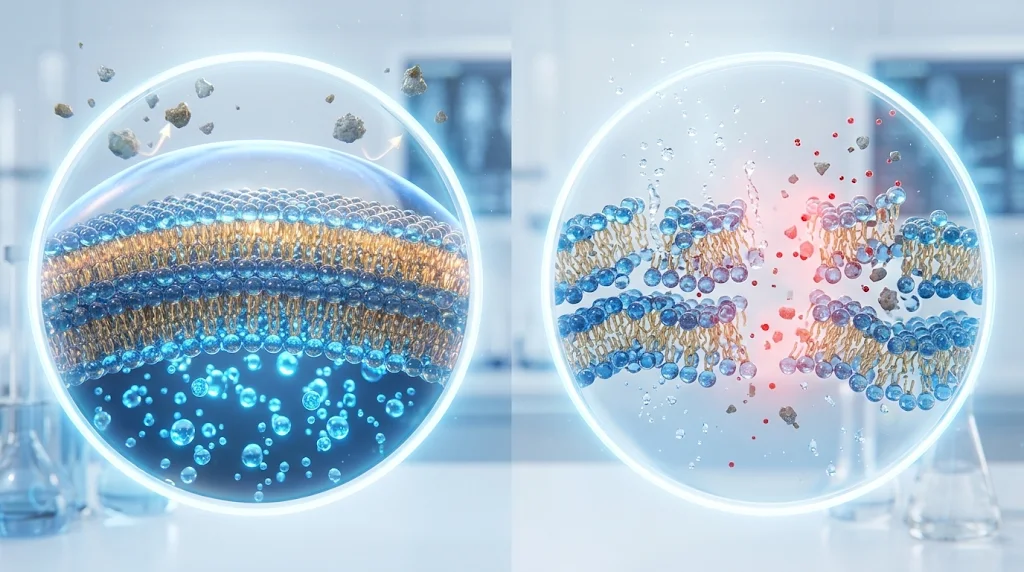
When dermatological researchers analyze healthy human intercellular lipid mortar, they find an equimolar balance composed of three essential lipid classes:
- Ceramides (~50% by weight): Structural sphingolipids (such as Ceramide NP, Ceramide AP, and Ceramide EOP) that anchor the lipid layers together.
- Cholesterol (~25% by weight): A sterol molecule that regulates membrane fluidity and plasticity, preventing the skin barrier from becoming overly rigid or brittle.
- Free Fatty Acids (~10%–15% by weight): Long-chain saturated and essential fatty acids (like stearic acid and linoleic acid) that pack tightly between ceramide tails.
The 3:1:1 Molar Ratio Rule in a Clinical Ceramide Barrier Cream
Landmark dermatological research published via the National Library of Medicine (PubMed) by Dr. Peter Elias and colleagues demonstrated a foundational law of epidermal biology: applying any single physiological lipid alone disrupts the lamellar organization of the stratum corneum and slows down barrier recovery.
By contrast, when Ceramides, Cholesterol, and Free Fatty Acids are formulated together in a 3:1:1 molar ratio (three parts ceramides to one part cholesterol and one part free fatty acids), the lipids spontaneously self-assemble into orthorhombic lamellar bilayers.
How Lamellar Liquid-Crystal Emulsions Work
Unlike conventional oil-in-water lotions that sit on the skin surface as random spherical droplets (micelles), a biomimetic ceramide barrier cream arranges water and lipid molecules into alternating, parallel sheets. According to clinical guidelines from the American Academy of Dermatology (AAD), mimicking the skin’s natural lipid structure allows moisturizers to seal micro-fissures directly within the stratum corneum rather than merely coating the surface like plastic wrap.
How Top R&D Labs Engineer an Effective Ceramide Barrier Cream
Because pure ceramides have a high melting point (often above 90°C) and tend to crystallize in standard emulsions, simply listing Ceramide NP at the bottom of an ingredient label does not guarantee results. Leading global R&D laboratories rely on patented delivery systems to stabilize their ceramide barrier cream formulas:
| R&D Laboratory & Flagship Brand | Proprietary Barrier Technology | Core Formulation Mechanism |
|---|---|---|
| Amorepacific (AESTURA Atobarrier365) | DermaON® Soft Capsules | Encapsulates a high-density 3:1:1 ratio of Ceramides, Cholesterol, and Fatty Acids inside visible lipid spheres that melt upon skin contact to prevent crystallization. |
| L’Oréal Dermatological Beauty (CeraVe Moisturizing Cream) | MVE® (Multivesicular Emulsion) | Traps Ceramides NP, AP, and EOP alongside Cholesterol and Phytosphingosine inside concentric lipid spheres that release hydration layer-by-layer over 24 hours. |
| LG H&H (Physiogel DMT) | BioMimic Technology® | Uses high-pressure microfluidization to create a surfactant-free lamellar matrix utilizing Hydrogenated Lecithin, Phytosterols, Ceramide NP, and Triglycerides. |
| L’Oréal Luxury (SkinCeuticals Triple Lipid Restore) | 2:4:2 Cholesterol-Dominant Ratio | Adjusts the lipid balance to 2% Pure Ceramides, 4% Natural Cholesterol, and 2% Fatty Acids specifically tailored for mature skin experiencing age-related cholesterol loss. |
3 INCI Checkpoints Before Buying Any Ceramide Barrier Cream
Before purchasing your next moisturizer, flip the bottle over and audit the INCI (International Nomenclature of Cosmetic Ingredients) list using these three formulation rules:
- Verify the Complete Lipid Triad: Ensure your ceramide barrier cream pairs at least one Ceramide (
Ceramide NP,Ceramide AP,Ceramide EOP, orCeramide NS) withCholesterol(or plant-derivedPhytosterols) and a fatty acid (Stearic Acid,Palmitic Acid, orLinoleic Acid). - Look for Lamellar Stabilizers: Ingredients like
Hydrogenated Lecithin,Phytosphingosine, andCetearyl Alcoholstabilize liquid-crystal lipid sheets so ceramides penetrate smoothly without recrystallizing. - Audit the “1% Line” (Phenoxyethanol Marker): In cosmetic formulations, preservatives like
Phenoxyethanolor1,2-Hexanediolare typically capped at 1% or less. If every ceramide sits at the very bottom of the label with zero cholesterol present, the formula is relying on “fairy-dusted” trace amounts rather than clinical barrier science.
Routine Takeaways: Getting the Most From Your Ceramide Barrier Cream
- Ditch single-lipid serums for severe dryness: Without cholesterol and free fatty acids to regulate membrane fluidity, isolated ceramides cannot form stable lamellar bilayers.
- Match the lipid ratio to your skin concern: Over-exfoliated, retinoid-peeling, or eczema-prone skin responds best to a 3:1:1 ceramide barrier cream, while mature, lipid-depleted skin thrives on cholesterol-enriched (2:4:2) formulas.
- Apply within the 60-second damp window: Lamellar lipid matrices require water molecules to organize into alternating sheets—always apply your ceramide barrier cream immediately after cleansing or misting.
Coming Next in This Cluster (
01-B): Ready to upgrade your moisturizer? Read our upcoming chemist comparison of the 5 Best Biomimetic 3:1:1 Ceramide Barrier Creams on Amazon That Outperform $150 Luxury Jars.
Editorial Note: All formulations analyzed on Cosmetic Formula Lab are independently evaluated based on published clinical dermatology literature and INCI chemistry. See our Editorial Policy.
Disclosure: As an Amazon Associate, Cosmetic Formula Lab earns from qualifying purchases at no extra cost to you. Full Disclosure.